Bachelor's Degree in Tourism Management
Travel, relaxation, experiences – the tourism industry is both dynamic and exciting. Working in this sector requires not only knowledge but also certain key skills.
In the exciting day-to-day business of tourism, you will learn to master management tasks, implement projects competently and contribute specialist knowledge. You will acquire sound business management skills, tourism-specific expertise and intercultural competence.
Study tourism – and hone your profile in a targeted way
Are you passionate about a particular subject? You can tailor
your degree programme at our department to suit your own interests and choose from our wide range of specialisations.
Sharpen your profile and match your interests by choosing two specialisations!
Our specialisations – choose two!
Shaping the future

How can tourism be organised in such a way that it is both attractive and responsible? In this specialisation, you will explore the fundamentals and current developments relating to sustainability in tourism. You will learn how the concept of sustainability has evolved within tourism and which tools are used to promote greater sustainability.
In practical projects, you will, for example, evaluate selected sustainability concepts from tourism projects or develop new solutions together with your student team.

How are working environments in the tourism sector changing? And what does leadership mean in the context of corporate, employee and self-management? What role do HR and managers play in shaping ‘New Work’? In this specialisation, you will explore current trends and developments in the fields of leadership and HR management.
Through practical projects, you will develop strategies to tackle current challenges, familiarise yourself with HRM tools and techniques for self-management and team leadership, and put your leadership skills to the test.
Bringing destinations to life

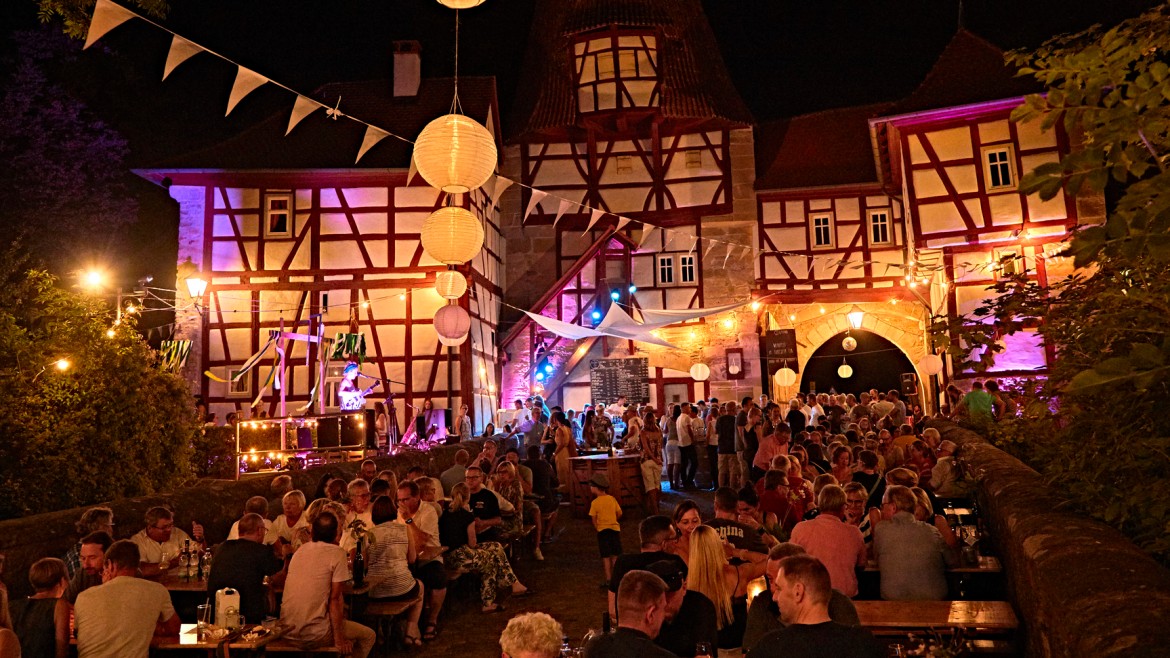
Culture is not only one of the most important attractions in tourism, but – in times of demographic change – is also increasingly becoming a location factor for businesses and their staff. In this specialisation, you will explore current developments and trends in cultural events.
You will apply the basic knowledge you have learnt about culture in tourism as part of a practical project, such as excursions to the Roman Road, the Limes in Bavaria, or ‘indoor’ cultural activities such as visits to museums or the theatre.

How can the impact of tourism on protected areas be studied? They examine current developments and trends in outdoor and sports tourism, and take an in-depth look at the economic and tourism-related effects of major sporting events.
In practical projects, you will, for example, develop solutions for mountain biking in the Zugspitze region or analyse the urban surfing scene in the Munich area.
They focus on key knowledge and methods relating to the strategic development, marketing and management of tourist destinations. The ‘Destination Development’ sub-module focuses on the analysis, positioning and sustainable development of destinations. Destination Marketing covers brand management, targeting specific audiences and digital communication. ‘Selected Issues in Destination Management’ addresses current challenges such as overcrowding, climate change and stakeholder coordination. Application-oriented projects, guest lectures and field trips combine theory with practice.
Helping to shape digitalisation
How are trips and destinations discovered, planned and marketed online today?
Instagram, Google, TikTok, AI, apps and platforms are changing the way people discover, plan and book holidays.
In this specialisation, you will learn to understand digital trends, reach target audiences and develop creative marketing ideas. From the customer journey through to digital campaigns and your own content production.
You’ll work on real-world projects alongside industry experts from leading companies and develop your own ideas, which you’ll put into practice straight away.

How can augmented reality (AR) and virtual reality (VR) be used professionally, particularly in the tourism sector? In this in-depth module, you will explore the latest developments and trends in the world of business intelligence. You will learn how data can help you make informed decisions.
For example, you analyse tourism-related geospatial data using database systems, statistics and artificial intelligence.
Managing and developing hospitality

You will learn about key areas that shape day-to-day operations in hotels and catering businesses. These include human resources management, legal principles, and the development and management of brand-oriented catering concepts.
With a focus on the industry’s current challenges, you will develop innovative solutions, learn about best practices and the latest research, and engage in discussions with industry representatives.

How do international hotel groups develop successful strategies? And how do specialist consultancy firms and project developers support the hospitality sector in seizing opportunities and overcoming challenges? In this special feature, you will explore key strategic approaches within the hospitality industry.
In practical projects, you will take the lead and examine how key companies and stakeholders go about planning hotel projects, for example.
Researching mobility

In this special feature, you will explore the latest developments and trends in the transport sector.
For example, they take on the role of a tourism director for a destination or the role of a manager of a transport operator.
Together with your fellow students, you will develop and evaluate regional mobility concepts for a tourist destination as part of practical projects.
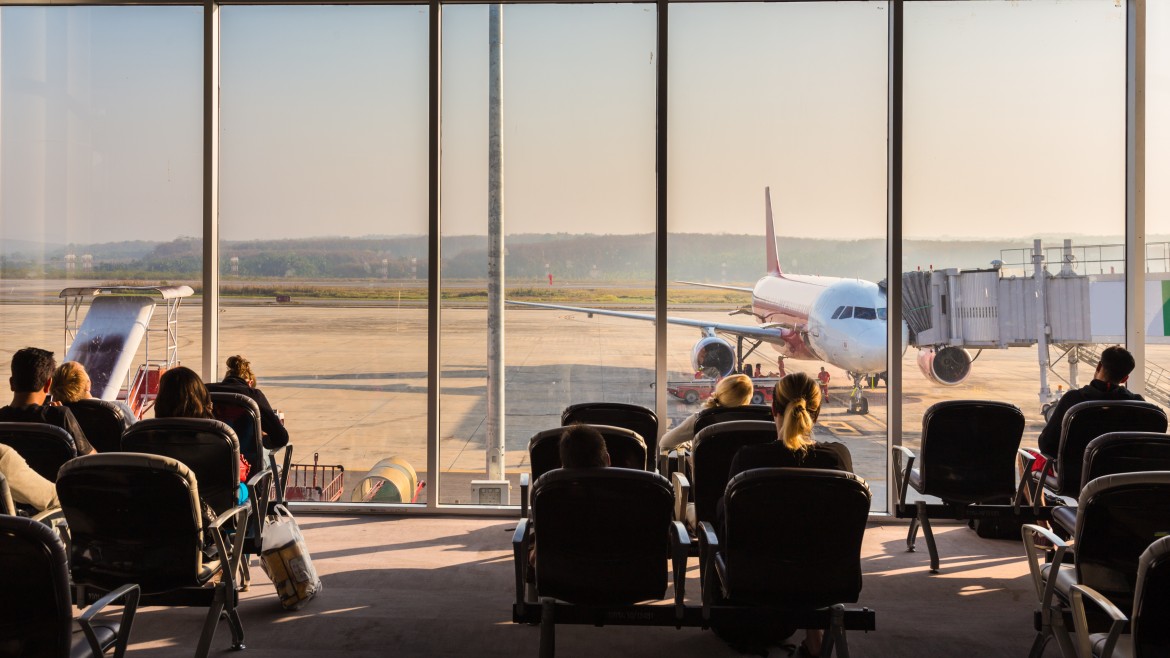
Set up and manage your own airline in the airline simulation game! Airline financing, fleet planning, route network planning, cabin product. You’ll also learn about the airport as a business: customers, departments and organisation. How important is air transport to the economy? What makes human resources management for airports and airlines so distinctive?
On a field trip (usually to a small and a large airport and/or an airline), we get to experience aviation operations first-hand.
Managing and understanding businesses

In this specialisation, you will expand your basic knowledge of business administration and law, which is essential for many roles and responsibilities within a company as well as for setting up a start-up. The wide range of career opportunities across all sectors, as well as in tax consultancy and auditing, is an added bonus.
Good to know: expertise in accounting, taxation and law is a fundamental prerequisite for taking on leadership and management roles.

In the ‘International Accounting’ module, we analyse the annual reports of selected large companies: where are they operating – and where are they successful? You will also learn the basics of international accounting.
The ‘Corporate Finance’ section is all about the capital markets: where can you make money … and lose it? How do you value companies? Why do they go public? And: how do I develop my own investment strategy?
You’ll develop skills for your future: confidence in working with numbers, communicating and making well-informed decisions.
Discover the world in the 5th semester

In your 5th semester, you have a choice: either study abroad at one of our partner universities around the world, or study on campus in English with international visiting lecturers.
Go directly to our "International Office
"

What do our students say?


Course structure
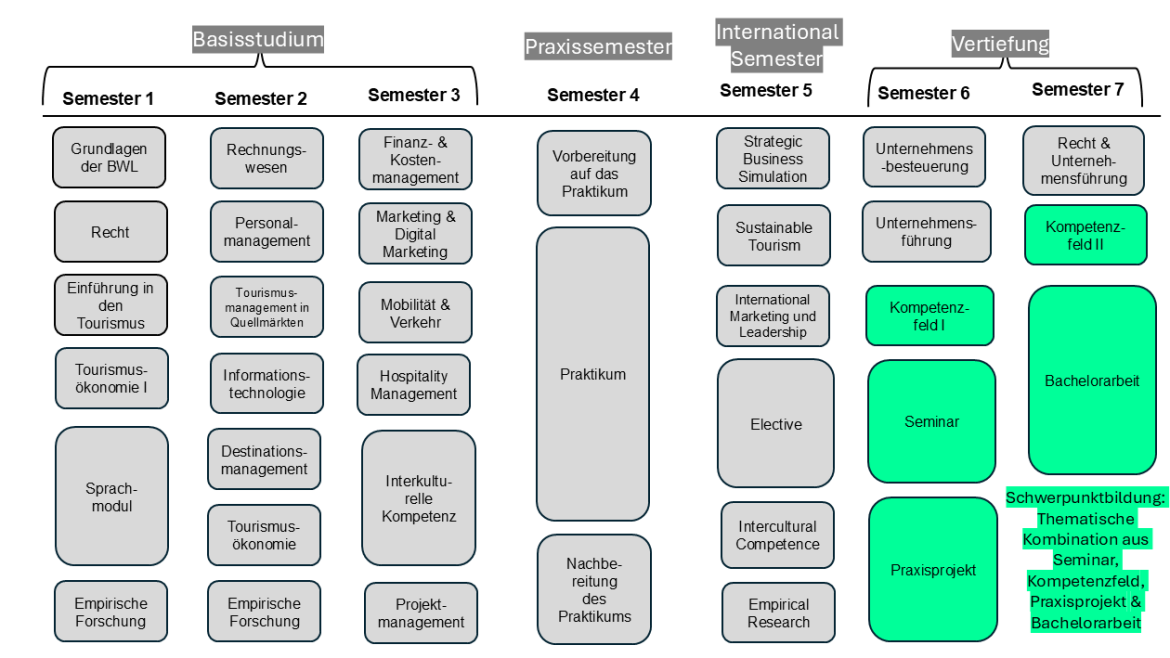
Semesters 1-3: Foundation
Focusing on the core subjects of business administration, tourism management, economics and intercultural competence
Semester 4: Practical semester – an
internship in Germany or abroad
Semester 5: International Semester
Study abroad or English-taught courses
Semesters 6-7: Specialisation with a focus on specific areas: Individual specialisation through a targeted combination of areas of expertise, practical projects and seminars; culminating in a bachelor's thesis.
1st semester: Business Administration, Tourism Management, Intercultural Competence and Methodological Skills
You will gain important fundamental knowledge in the four core areas:
- Business Administration: Fundamentals of Business Administration, Civil Law and Accounting
- The Tourism Industry and Economics: An overview of the tourism industry, as well as selected management techniques and fundamental interrelationships between tourism economics and macroeconomics
- Intercultural competence: linguistic, cultural and practical skills through the learning of a second foreign language (French, Spanish, Chinese, etc.)
- Methodological competence: Basic knowledge of mathematical and analytical methods
2nd semester: Focus on Business Administration –
Fundamental knowledge in the following areas:
- marketing and organisation, as well as
- private commercial law and business accounting
In the tourism modules, the focus in the second semester is on source markets – the regions from which travellers and visitors come.
- Business models and key processes of typical source market companies such as travel agencies and tour operators
- Business informatics with a focus on IT applications in the tourism sector
- Destination management from the perspective of regional development
3rd semester: Focus on the tourism industry
In the field of business administration, in the third semester you will learn:
- the fundamentals of cost and performance accounting, management accounting and taxation
- in-depth knowledge of (digital) marketing
In the field of tourism management, the focus here shifts to the destination areas – that is, the regions and locations around the world to which visitors travel.
- Mobility and transport in tourism
- Operational and strategic hospitality management
- Intercultural competence
In terms of methodologies, the focus is on project management.
4th semester: Practical semester
During the practical semester, you will have the opportunity to apply and build upon the theoretical knowledge and abilities you have acquired so far in a practical setting. As part of the courses that accompany the internship, we will prepare you for your internship, whether it is in Germany or abroad. A debriefing session will take place following your internship.
5th semester: International Semester and Business Simulation Game
This semester is all about internationalising your degree programme. In this 5th semester, study at one of our department’s more than 50 partner universities around the world!
For those who do not go abroad, the lectures for the semester will be delivered in English. You will also have the opportunity to meet many international visiting Professors here.
- Strategic Business Simulation
- Intercultural Competence
- Electives: Tourism Industry, Hospitality, Current Issues in Tourism, Digital Tourism Economy
- International Marketing and Leadership
- Sustainable Tourism
6th and 7th semesters: Choose your own areas of specialisation!
During the final two semesters of your degree, you will enjoy a great deal of freedom in choosing your modules.
A tailored combination of a specialisation area, a practical project and a seminar enables you to set your own individual priorities.
Business administration subjects, such as corporate management and taxation, prepare you for a career in management.
The bachelor's thesis takes up half of the seventh semester. In your academic thesis, you will explore a topic relevant to the tourism industry, which will yield important insights for professional practice.
Through the targeted combination of areas of specialisation, practical projects and seminars, you have the opportunity to tailor your Bachelor’s degree programme at our department to your personal interests and professional goals (e.g. by choosing a specialisation).
What is an area of specialisation?: An area of specialisation comprises various thematically related modules totalling six hours per week. In addition to seminar-based teaching, these courses make extensive use of practical examples, talks by industry professionals and field trips.
What is a practical project?: You work with a small team on a specific practical problem. Practical projects not only provide you with excellent practical insights, but also deliver valuable contributions to external partners. In numerous cases, these partners have already translated the findings provided by students at Hochschule München into concrete measures. Practical projects often involve investigating a region’s tourism potential and the possibilities for marketing it. Excursions to the practice partners are arguably the most exciting phase of a practical project.
What is a seminar?: Seminars often focus on specific issues raised by tourism companies. Through the seminar papers you are required to write as part of a seminar, you gain valuable experience in producing academic work, which will stand you in good stead when writing your bachelor's thesis in the 7th semester. You will also learn how to present content correctly from a methodological and didactic perspective and how to discuss academic questions.
What is a bachelor's thesis? The bachelor's thesis takes up half of the seventh semester. In your academic thesis, you will explore a topic relevant to the tourism industry, which will yield important insights for professional practice.
application
Students may commence the bachelor's degree programme in either the winter semester or the summer semester.
Application period for the winter semester: 2 May – 15 July of the current year
Application period for the summer semester: 15 November – 15 January of the current year.
Entry requirements:
Admission to the degree programme requires either a general higher education entrance qualification, a subject-specific higher education entrance qualification or a university of applied sciences entrance qualification. Admission is also possible for holders of a ‘Meister’ qualification or equivalent qualifications.
Numerus Clausus (NC)
As the bachelor's degree programme in Tourism Management is a programme with restricted admission, admission is determined by a Numerus Clausus (NC). The NC is set anew each year once all applications have been received.
Further information on applying for bachelor's degree programmes
A sound knowledge of English is required from the start of the programme. This means at least A-level English or level B2 according to the Common European Framework of Reference for Languages. This is also equivalent to the FCE (First Certificate in English), BEC Vantage (Business English Certificate) and UNIcert II (English).
Prior knowledge of other languages (French, Spanish, Italian, etc.) is not required, as these language skills can be acquired during the course.
Outlooks
Our modern bachelor's degree programme in Tourism Management will equip you to take on challenging roles in the tourism and service sectors. We aim to enable you to master management tasks within the dynamic day-to-day operations of the tourism industry, implement projects competently and contribute your expert knowledge.
Specifically, our bachelor's degree programme in Tourism Management will provide you with the following skills:
- a sound grounding in business administration,
- specialist knowledge specific to tourism,
- methodological skills and
- intercultural competence
Good to know: As the department with the broadest and most in-depth teaching expertise in tourism in Germany, we are able to offer you this comprehensive range of courses, many of which are interdisciplinary in nature. We have a wide range of international links and partnerships with industry – for you as a student, this means excellent opportunities to spend a semester abroad and close links to the industry, for example through seminars, practical projects and final-year dissertations.
At the cutting edge: We are also active in Applied Research, the latest findings of which enrich our teaching programme and ensure it remains ‘at the cutting edge’.
More than almost any other sector, tourism is a ‘people business’.
The bachelor's degree programme in Tourism Management aims to prepare you for roles in middle and senior management in the following areas:
- Tour operators and travel agents
- Destinations
- Public administration
- Hotels and resorts
- Catering
- IT
- Tourism organisations, associations and policy
- Transport and haulage companies
- Air transport companies
- Conferences and trade fairs, event management
- Holiday and leisure centres
- Spas and health resorts
- National Parks and Nature Conservation
Application-oriented, academic further qualification
And if your thirst for knowledge has not yet been quenched – whether immediately after your bachelor's degree or following a few years’ professional experience – the bachelor's programme also provides the foundation for application-oriented, academic further qualification through a subsequent Master’s programme. Our three-semester master's degree programmes in Strategy and Innovation in Tourism
and Hospitality Management
will equip you for demanding specialist and managerial roles in the tourism industry.